
Nobody Sold
morning musings 7.24.26- views from the island

"One of these things is not like the others." Sesame Street
India ordered 93 million biryanis last year. Then 44.2 million burgers and 40.1 million pizzas. Visual Capitalist / Times of India
The two imports together come to 84.3 million, inside a whisker of the national dish. Not because they are better. Because they are legible. You know what is coming before it arrives.

That is what convergence looks like. Not conquest. Convenience.
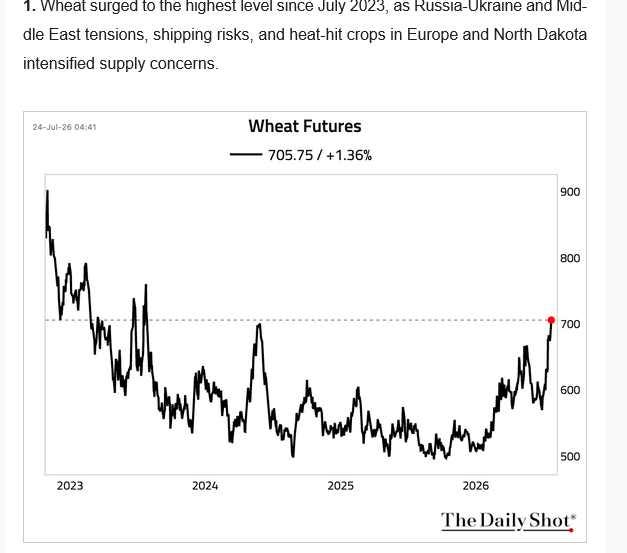
Wheat printed 705.75 this morning, the highest since July 2023, on corridor attacks, shipping risk and heat damage in Europe and North Dakota Daily Shot. So the dough is repricing. Japanese wholesale eel is down 26.8% year over year on a fat elver catch and eight times the Chinese stocking Nikkei Asia. Same mechanism, opposite signs, and only one of the two gets written up as a supply shock.
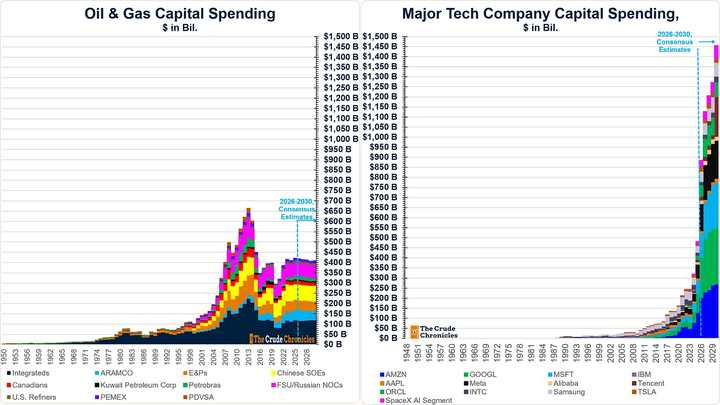
Markets ordered off a short menu this week. Long energy, short duration, short the capex hogs, short the haven that failed. Twelve documents crossed my desk before eight o’clock and eleven of them had ordered the burger.
Here is the part that stopped me. Retail sentiment just had its worst week since September 2021. And nobody sold a thing.
Which brings me to the pineapple. Every book has one leg on it that would never get ordered fresh this morning. It is there because it worked on Thursday. Sweet, defensible if you squint, and an offense against the thing it is sitting on.
So. Which one is yours?
TL;DR
The curve is bear flattening and everyone has written it up as a steepener. Two-year yields have risen 16bp over four sessions against 11bp on the ten-year, so 2s10s has gone +39, +37, +36, +34 US Treasury. That is a Fed-path repricing led from the front, not the fiscal term-premium shock the consensus is trading. It changes what the oil move means, it inverts the financials read, and it makes the crowded expression the wrong one.
Brent is 97.76, down 2.91%, having traded 96.41 to 101.16 FMP, 09:36 ET. It sold the ceasefire proposal, bought back the rejection, and sits 28% of the way up its own range. Havens are split rather than broken: dollar bid, yen offered at year lows, gold flat at 4,048.70, bonds offered through Thursday. That is a rotation, not a de-gross and not a crisis.
And the positioning is the tell. AAII bullish fell 15.3 points to 29.6%, the biggest weekly collapse since September 2021. Active-manager exposure is still in the eighties, macro net equity around 100%, systematic allocation mid-band with minimal deleveraging NAAIM, Daily Shot, T1A. Everybody got scared. Nobody got out.
MY READ
The consensus this morning is that a supply shock in oil pushed the term premium up and the Fed into a corner. I think the bond market is saying something else entirely, and it is saying it in a place nobody checked.
Run the four sessions. Two-year 4.21, 4.26, 4.31, 4.37. Ten-year 4.60, 4.63, 4.67, 4.71. The front end moved 16bp, the belly-to-long moved 11bp, and the curve flattened five basis points while the whole street wrote ‘bear steepener’ US Treasury.
Term premium steepens. It has to. A fiscal risk premium is a demand for compensation over time and it shows up in the tail. What flattens from the front is a policy rate being repriced. So this is not the deficit, and it is not really the war either. It is the market marking up how many hikes it thinks Kevin Warsh has in him, and doing it at the two-year point where hikes actually live.
Which reframes three things at once.
The oil trade is a weaker expression than it looks. Brent round-tripped today. Low 96.41, high 101.16, currently 97.76, which is 28% of the way up the range and $3.40 off the high FMP. Every brief on my desk marked it between 97.60 and 97.77 and called it ‘easing.’ They caught the wick, again. It sold off on the ceasefire proposal routed through Baghdad and bought back when Tehran rejected it NYT, WSJ, so the tape has already digested both halves of a story most of the street is still pricing one half of.
The financials read is upside down. A bear flattener is not a NIM tailwind. It is the opposite. Every research product in my stack has the group as a rates beneficiary on a steepener that is not happening, and Thursday’s tape already knew: banks fell 0.60% against financials at 0.39% prior close. The subsector that is supposed to be levered to the good version underperformed the sector.
And the pain trade has flipped, but not the way the crowd thinks. The consensus consolation is that Thursday flushed the trapped long and set up a squeeze. It did not. AAII bullish at 29.6% is a survey answer. NAAIM in the eighties, macro proxies near 100% net equity and systematic allocation sitting mid-band are what people actually did NAAIM, Daily Shot, T1A. There is no short base to squeeze and there is a full warehouse still to sell.
I am wrong if 2s10s prints back above +40bp on tonight’s Treasury close with the ten-year at a new high. That says term premium genuinely took the wheel and the fiscal story was right all along.
WHAT MATTERS TODAY
The front end is doing the work. 2Y 4.37, 10Y 4.71, 30Y 5.17, 2s10s +34bp US Treasury, 23 Jul. Market pricing roughly 42bp of hikes across the second half, with odds on next Wednesday dipping to about 30% from 40% R&R. Note the shape of that: July is live and September is priced near certain, which is a lot of conviction about a decision the Fed has spent a year saying it looks through.
Nobody agrees about the Fed and that is the opportunity. Rates markets price hikes. Bloomberg-surveyed economists still have the next move as a cut, pushed out to the third quarter of 2027 BBG. Bloomberg Intelligence expects a hawkish hold BI. Warsh has scrapped forward guidance and said the committee has no tolerance for persistently elevated inflation, with Waller, Logan, Hammack and Williams all leaning the same way and June minutes showing a few officials already made the case BBG. That is the widest gap between the market and the professional forecasters I have seen in this cycle, and it resolves Wednesday at two o’clock.
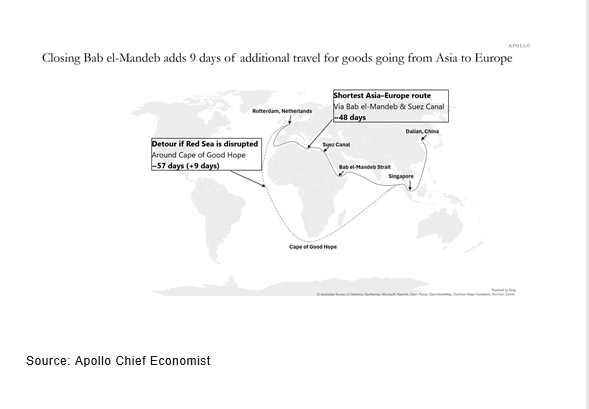
Oil round-tripped on a ceasefire that had already been refused. Trump put a proposal to Tehran through Iraq’s prime minister. Tehran rejected it, and reporting has him frustrated and in what one account calls revenge mode, having said he is considering an attack bigger than anything so far and is close to a decision NYT, WSJ, BBG. Crude sold the offer and bought the refusal. Into a weekend, with a second front open in the Red Sea, the gap risk is not symmetric.
The tariff arithmetic is smaller than advertised. Ten to twelve and a half percent on somewhere between 60 and 80-plus partners, and every account of the exemptions differs. Two say oil and gas are carved out, one says chips and steel, one says USMCA and national-security goods BBG, R&R, NYT. Four documents in my stack call this a second cost-push impulse stacking on crude. If energy is exempt, it is a footnote wearing an impulse’s clothes.
Cost is showing up in margins, not demand. American Airlines fell 8% on guidance and the entire reason is fuel: Q2 fuel expense up $2.2bn, 83% year over year, roughly half recovered through revenue, and since 1 July the Q3 line is up more than $700mm with $1.6bn for the balance of the year. In the last week alone it moved $230mm AAL call, via Boockvar. Premium unit revenue up over 13%, main cabin up nearly 9% and accelerating. Demand is fine. That is a cost-push event, and it is exactly the one the Fed says it looks through.
MOVERS THAT MATTER
INTC Q2 EPS 42c against 21c, revenue $16.1bn against $14.4bn, gross margin 41.8% against 39.2%, with Client, Data Center and Foundry all above plan. The Q3 guide is 38c on a $16.3bn midpoint against Street at 27c and $15.06bn. Stock up between 4% and 5% R&R, BBG.
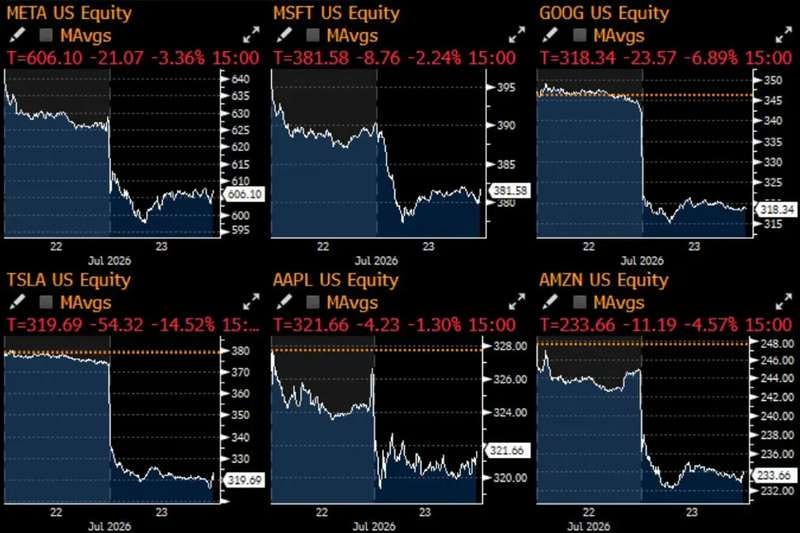
So what: the number that matters is the one nobody in my stack carried. Intel told the street it will meaningfully increase spending, roughly $20bn this year, and the tape paid up anyway. Three separate research products have Intel at +13% and use it to argue the market punishes capex. It did not. It paid for capex attached to expanding margin and a raised guide, and it took Alphabet apart for capex attached to neither. That is a dispersion regime, and it is a much narrower claim than the one being sold.
AAL down 8% on a guide that is pure fuel, with unit revenue accelerating underneath it.
So what: this is the cleanest transmission print of the week and it belongs in a rates note rather than an airlines note. When the shock lands in the cost line and not the revenue line, you do not get a growth scare, you get margin compression and a central bank with no excuse to cut. Watch transports and logistics, which finished Thursday green at +0.27% and +0.23% prior close, and ask how long that survives a fuel curve moving half a billion dollars a week.
ALB down 22%, identical sales off 0.8%, with management saying the weakness was most pronounced in lower-income segments across both units and baskets, and guiding cautiously on affordability company. Tractor Supply saying much the same about customers who drive long distances in diesel pickups.
So what: set that against American Express reporting card spending up 9%, the fastest in three years currency-adjusted, and raising its revenue guide company. Same week, same consumer, opposite direction. The consumer is not weakening, it is separating, and the separation is where the trade is.
FINANCIALS
The group is being underwritten on a curve shape that is not occurring.
Financials Daily has 2s10s as a bear steepener and builds a Life and Health overweight on rising long rates lifting spread income. The mega brief says steepening. The state log says steeper at +36bp. The Treasury’s own series says +39, +37, +36, +34 across four sessions, so the level is wrong in two documents and the direction is wrong in three US Treasury.
That is not pedantry, it is the whole thesis. Banks earn the spread. A flattener led by the front end raises funding costs faster than asset yields reprice, which is the wrong half of the trade, and Thursday’s tape said so before anyone did the arithmetic. Banks -0.60% against financials -0.39% prior close. The rate-levered subsector underperformed the sector on a day the ten-year hit a cycle high.
Run the internals rather than the sector and the dispersion is enormous. Financials -0.39%, banks -0.60%, BDCs -1.28%, fintech -1.63%, against leveraged loans -0.04%, high yield -0.36% and corporate IG -0.38% prior close. Credit barely moved. The equity of the lenders moved four times as much as the paper they hold. Whatever the market is worried about, it is not the loan book.
The KRE gate is moving the wrong way. The reactivation level is 2s10s at +60bp. It is +34 and it has flattened five basis points in four sessions. That is 26bp away and widening, not 24bp and closing US Treasury. Regionals are the highest rate-beta expression in the group and the curve is walking away from the setup that pays them. Stand down and stay stood down.
Where the actual edge is. Two hard consumer prints landed on the same day pointing opposite ways: Amex card spend +9%, fastest in three years, guide raised; Albertsons identical sales -0.8% with the damage concentrated in lower-income baskets. The bifurcation is not a theme, it is two earnings calls. Card charge-offs sit at 5.3% for SYF and 4.94% domestic for COF, with BNPL running as the four-to-six week leading indicator at AFRM 30-plus of 2.8% and Klarna reporting that 47% of users pay late company data, Financials Daily. The prime book is compounding and the subprime book is where the tariff-and-fuel squeeze lands first.
Two things to keep watching. Bank preferred reset spreads printed at post-crisis tights this week, with Goldman and Citizens following BNY Mellon, and seasoned buyers calling them ridiculously tight BBG. And private credit keeps gating quietly: BCRED cut its distribution to $0.18, a second cut in nine months, while non-traded BDC redemptions ran near 10% against a 5% cap and got prorated to roughly 62 cents on the requested dollar Financials Daily. Public high yield at an index OAS of 276bp is not confirming any of it BBG indices.
Insurance is the only part of the sector actually transacting. HSBC selling its Singapore life and health book to Allianz for $2.1bn, Safety Insurance to Mapfre at $1.54bn, Munich Re beating by a third on low catastrophe losses and raising guidance BBG, WSJ.
So what: own the split, not the sector. The pair that works here is quality consumer credit against the subprime-tilted end, and the trade that does not work is any expression that needs the long end to steepen away from the front.
SECTORS
Thursday’s close, and the dispersion inside it is worth more than the index number.
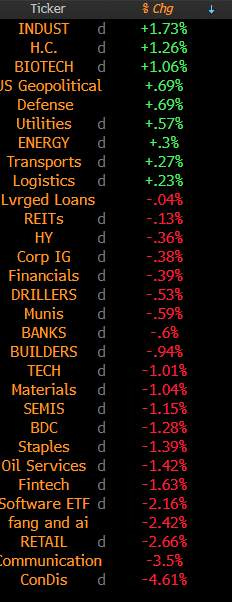
XLI +1.73%. The only real leadership. Defense and geopolitical baskets both +0.69%, United Rentals raising its outlook on non-residential, power and data-center work
XLV +1.26%. Biotech +1.06% alongside it, and Tenet’s beat-and-raise gapping 18% against HCA’s cut. Company execution, not sector rotation
XLU +0.57%. Quiet bid. The power-demand story keeps working whether or not the AI equity works
XLE +0.30%. Green at the headline and rotten underneath: drillers -0.53%, oil services -1.42%. The commodity moved and the service complex did not follow, which is what you get when the market thinks the premium is geopolitical rather than structural
XLRE -0.13%. Barely moved with the ten-year at a cycle high. Data-center REITs are carrying it
XLF -0.39%. Banks -0.60% underneath. See above
XLK -1.01%. Semis -1.15%, software -2.16%, and the FANG-plus-AI basket -2.42%. The de-rate is concentrated in the platforms, not the silicon
XLB -1.04%. Which is a problem for anyone who told you materials were leading the reflation rotation yesterday
XLP -1.39%. Staples down with the market. No defensive bid at all, and Albertsons is the reason
XLC -3.50%. Alphabet is the sector
XLY -4.61%. Retail -2.66% on top of Tesla. The tariff pass-through and the fuel squeeze meet the low-income consumer here first
FLOWS & POSITIONING
The survey capitulated. The book did not.
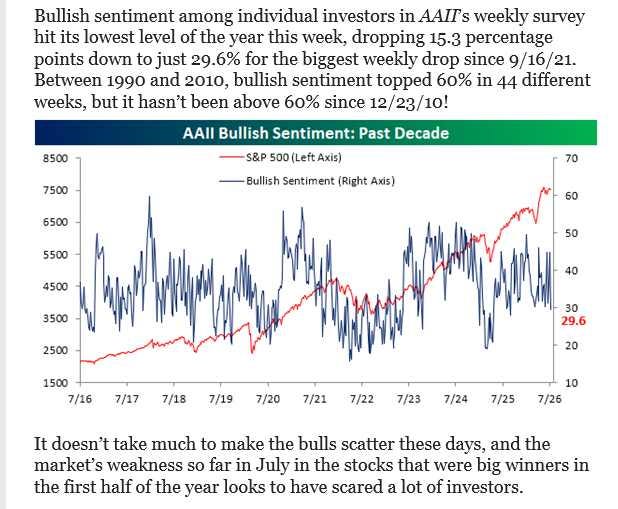
AAII bullish 29.6%, down 15.3 points on the week. Lowest of the year, biggest one-week drop since September 2021, and a change large enough to sit in the tail of a series running back to 1987 AAII. Bull-bear negative again. On paper, retail is finished.
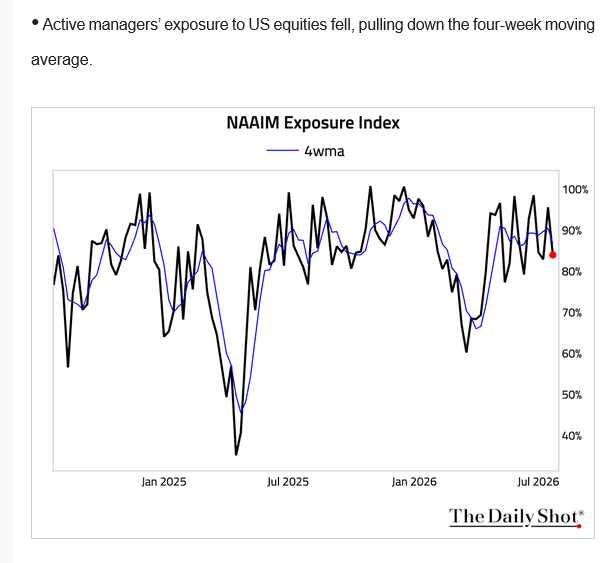
Then check exposure. NAAIM still in the eighties with the four-week average only now rolling NAAIM. Global macro proxy net equity around 100%, off slightly, rebuilt from roughly 40% in April Daily Shot / Unlimited Funds. Systematic allocation mid-band, CTA and vol-control models intact, minimal deleveraging Thursday T1A.
Scared and still long. There is a word for that and it is not washout.
Which matters for a specific reason. The squeeze case needs a short base and there is not one. The de-gross case needs inventory and there is plenty.
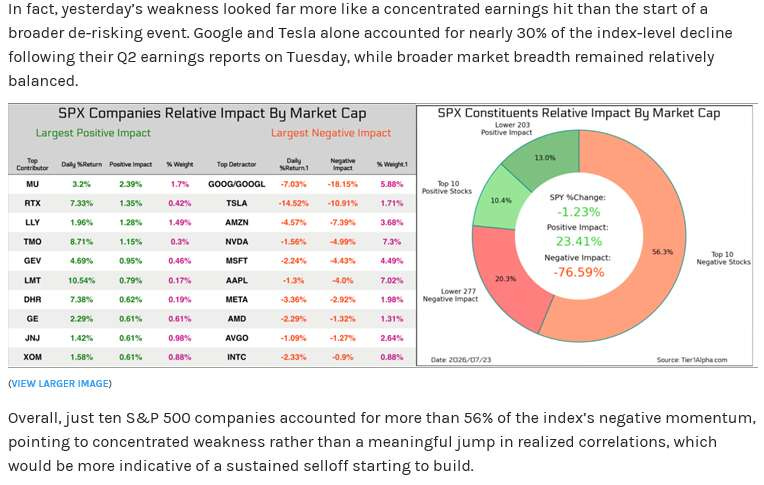
Note also what Thursday actually was. 213 advancing, 287 declining. Ten names carried 56% of the negative impact and two of them, Alphabet and Tesla, did nearly 30% of the index decline between them T1A. Breadth stayed roughly balanced. That is a concentrated earnings hit wearing a risk-off costume, and four documents on my desk call it a rout.
And the level everyone is watching already got tested. Tier1Alpha puts negative-gamma acceleration below 7,400. Thursday’s intraday low was 7,376 and the close was 7,408.30 FMP, prior close. The market went through it by 24 points, systematic models held, and it closed back above. The trigger has been pulled once and nothing happened, which is a different setup from a trigger sitting untouched eight points below.
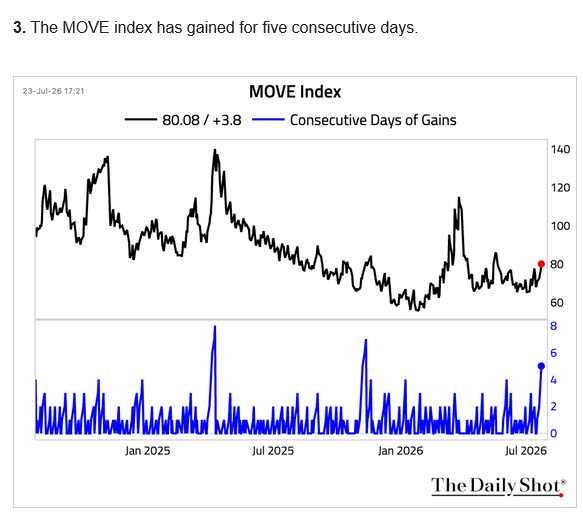
The tell nobody is writing about. MOVE closed 80.08, up 3.8, a fifth consecutive daily gain Daily Shot. VIX is 18.86 FMP, 09:36 ET and bid on a green futures morning, but it is nowhere near stressed and it is 3.1 points from the level that would force anyone to cut gross. Rate volatility is compounding while equity volatility naps. The market has priced its fear in the curve and left the tape unhedged.
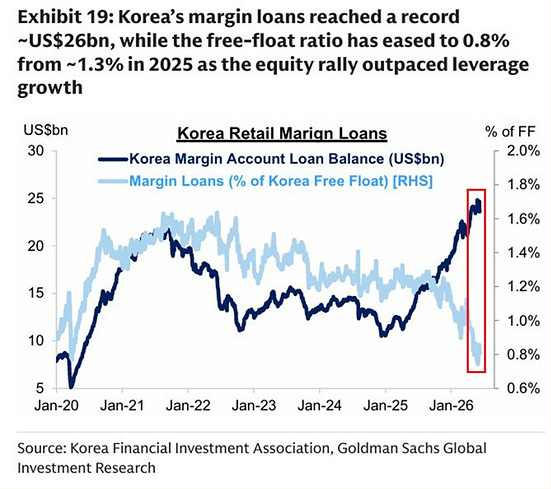
Korea is a margin story, not a demand story. Margin balances at a record $26bn absolute, with the free-float ratio down to 0.8% from about 1.3% as the rally outran the borrowing Goldman / KOFIA. Goldman reads the ratio and calls it contained. Margin calls do not fire on aggregate free float, they fire on account equity. KOSPI -5.72% with Samsung -7.6% and SK Hynix -8.3%, and both report into the meeting: SK Hynix Tuesday night, Samsung Wednesday night R&R.
Read the whole thing at morningmusing.com.
Keep reading with a 7-day free trial
Subscribe to Morning Musings- Thoughts from Dauber Island to keep reading this post and get 7 days of free access to the full post archives.