
Does Anybody Get That?
morning musings 7.27.26-views from the island


"The first principle is that you must not fool yourself, and you are the easiest person to fool." Richard Feynman

Friday night at the Waldorf, the President told a joke about term limits, something about politicians who eventually can’t get up the stairs to meet their wives. Nothing. Not a ripple in a ballroom of two thousand people who are professionally obliged to be polite.
So he stopped. Looked at the room. And asked it: “Does anybody get that?”
Then he answered himself. It was, he said, “the only thing I thought was good in this whole freaking stupid speech.” (Fox)
An hour and four minutes of this. He called Jake Tapper ‘Fake Tapper’ to complete silence, and Tapper wasn’t even in the building. He told Kaitlan Collins to smile, minutes after she collected an award for the very reporting he was calling fake. Anderson Cooper. Josh Dawsey, also honored that night. Adam Schiff’s ‘watermelon head’. Then the red hat out from behind the lectern, TRUMP 2028, and a promise to run again. (CNN) (NPR) (Axios)
And the man’s conclusion, delivered live, was that the writing was the problem.
The market did the identical thing this weekend. It heard a headline, decided it was the punchline, and laughed on cue. Nobody in the room has actually heard the joke yet.
TL;DR
Brent is 89.49, down 7.53%, and here is the part nobody printed: it opened at 93.89, flushed to 87.57, and bounced. It is sitting 30% up off its own session low. Every note I saw when I got up, written between 6:15 and 6:52 this morning, says oil is roughly 88 and falling, and every one of them is describing a moment that has already passed. Crude sold the de-escalation and then refused to stay sold.
That matters because the entire relief trade rests on one assumption, that the pause is diplomacy. It isn’t. Twice now the United States has stopped shooting because it was running out of things to shoot with. In June at Évian it was oil reserves, four weeks of them by the President’s own count. This month it is interceptors, roughly half the Patriot inventory gone in seven weeks, with commanders in theater now choosing which incoming missiles to engage and which to let land. A pause driven by your own supply chain is a resupply window. Resupply has a schedule. Settlements don’t, and there isn’t one.
The index is fine. The inside of it is coming apart. Momentum factors fell between 2.9% and 8.0% on Friday alone. Value caught a bid. The Goldman retail favorites basket has round-tripped from up twenty to up two while SPY holds nine. The S&P closed Friday below its 50-day. The Nasdaq is 4.2% below its. This is a rotation dressed as a rally.
And the bond market barely blinked. The 10-year is 4.6446, down three and a quarter basis points. The 2-year is 4.3158, down a point and a half. A seven and a half percent collapse in crude moved the entire Treasury curve less than four basis points. That is not a market that believes the inflation scare is over. That is a market that never thought oil was the problem.
Wednesday is Warsh’s last clean meeting. October 27-28 sits six days before the midterms. And today is exactly 100 days out.
MY READ
The consensus this morning is that a supply premium is unwinding and the crowd that leaned short into Friday’s close is trapped. Fine, as far as it goes. It goes about six hours.
My variant is that the market has misread the mechanism, and the mechanism is the whole trade.
Everyone is pricing the pause as the first rung of a diplomatic ladder. Oman channel, Hormuz talks, Tehran halting retaliation. The reporting says otherwise, and it says it twice. Back in June at the G7 closing press conference in Évian-les-Bains, Trump explained plainly why he had called a halt: continued bombing would not reopen the Strait, and while the war ran, commercial ships stayed away while emergency supplies drained. “We run out of reserves in about four weeks,” he said, and reached for Hoover and 1929. (The Atlantic)
This weekend, the same thing with a different inventory. The Journal has the military poised Friday for an intensive series of strikes that could have run two weeks, delayed while officials argued about the effect on Patriot and other interceptor stocks. The Times has General Dan Caine telling the room a larger campaign was possible but would dangerously deplete the interceptors protecting American forces in theater, and Vance warning on escalation, with few in the inner circle backing the wider war. NBC has two senior officials describing commanders now triaging incoming missiles and drones, deliberately letting some land to conserve the magazine. CSIS analysis matching classified Pentagon estimates puts seven-week consumption at roughly 45% of Precision Strike Missiles and nearly half of Patriot interceptors, four million dollars a shot against drones that cost tens of thousands. (WSJ) (NYT) (NBC) (CSIS)
Trump’s line to the Journal: “we have far more munitions than anyone in the world, and far more than we need.” Waltz on Meet the Press yesterday conceded stockpiles were depleted, blamed the previous administration, was pressed twice, reversed, said the military has everything it needs, and then said the people leaking this deserve to be in jail. Welker reminded him the President promised five to six weeks and we are at five months. Waltz reached for “47 years.” She cut him off: not in this capacity. (WSJ) (NBC)
So: the pause is a magazine problem. And a magazine problem has a delivery date, which is a very different object from a peace framework. You can schedule resupply. You cannot schedule Tehran deciding it has had enough, and Alexander Stahel’s crossings work is the reason to doubt it will. Kpler logged 2,143 transits of Hormuz between 28 February and 24 July, 14.6 a day against a pre-war rate well over 80. Nineteen percent, for five months. In the six days to 24 July, 34 crossings total. Five point seven a day. Seven percent of normal. (The Commodity Compass)
That is not a chokepoint easing. That is a chokepoint that has been effectively closed for five months and is being traded as though it reopened on Friday.
Which is the answer to the question I keep coming back to. Why does crude dump eight percent every single time the shooting pauses, when no settlement is anywhere in sight?
Because the paper market prices headlines and the physical market prices barrels, and right now those two are looking at different objects. The futures curve is trading a diplomatic narrative. The tanker data is trading a strait at seven percent throughput. When those disagree this violently, the reconciliation is usually unkind to whoever was reading the newspaper.
And the tape already knows. Brent flushed to 87.57 and bought itself back to 89.49. Silver printed 60.395 and sits at 59.445, twelve percent of its day range, fading. Both are the same message: the disinflation impulse got priced, and then partially rejected, inside a single session. Every desk that snapshotted at 6:30 has the flush and not the rejection.
And the curve is the confirmation. Crude fell seven and a half percent and the 10-year came in 3.2 basis points, the 2-year 1.5. Less than four basis points of relief across the whole structure. If the market believed the cost-push story had ended, the front end would have ripped and you would be looking at a bull steepener. Instead the curve flattened by under two basis points, which is another way of saying nothing happened at all. (BBG, 08:39 ET)
My read: the war premium is being de-risked. The term premium is not being de-rated. Those are different trades and the market is conflating them. Own the second, fade the first, and hold cheap optionality on the pause ending on a schedule rather than on a signature.
I’m wrong if Brent closes below 87.00. That kills the refusal-to-stay-down read and says the de-escalation is being priced as durable, in which case the whole reinflation structure deflates and I want to be somewhere else entirely.
WHAT MATTERS TODAY
The levels.
Brent 89.49, gold 4,104, silver 59.445, VIX 17.71, USD/JPY 163.60, EUR/USD 1.13932, USD/CAD 1.41016, all pulled between 07:13 and 07:43 (FMP). Treasuries off the terminal at 08:39: 10-year 4.6446, down 3.24bp, 2-year 4.3158, down 1.48bp, 2s10s +32.9bp (BBG).
Which is a smaller move than it sounds like and a bigger tell than anyone is treating it as. Friday’s par curve closed at 4.69 and 4.33 for +36bp (US Treasury). So the entire repricing of a five-month war premium, on the day the shooting stopped, was three basis points at the ten and one and a half at the two. The curve flattened by under two. Nobody sold the inflation story. They just stopped buying it slightly.
Wednesday, and the arithmetic of a closing window.
The FOMC decides Wednesday at 2pm with a Warsh press conference at 2:30. A hold is the heavy favorite. What is being underpriced is that this is the second-to-last meeting Warsh gets before the calendar takes the decision away from him. September 15-16 is the last clean one. October 27-28 lands six days before the midterms, which is not a meeting at which a central bank moves rates unless it enjoys the resulting decade of hearings.
Then the piece almost nobody has connected. The Bureau of Economic Analysis is changing how it prices three categories inside core PCE, portfolio management and investment advice, legal services, and computer software. Goldman and JPMorgan both estimate May core going from 3.4% down to 3.2 or 3.3%. Bloomberg’s calculation is thirteen basis points. Citi called it a big deal on 30 June. It applies retroactively to 2021, so five years of inflation history get rewritten in one release. (BEA) (Morningstar)
That release is 30 September. The September FOMC is 15-16 September.
So Warsh takes his last uncontested shot on a core PCE number that his own government has already announced it will revise lower two weeks after he acts on it. To be fair, and I want to be fair here, the portfolio-management flaw is real and was flagged in prior Fed research. Tying advisory fees to the level of the stock market measures the wealth effect, not consumer prices. The fix is defensible. The timing is also extraordinarily convenient, and both of those things can be true at once.
The tariff clock nobody watched.
After the Supreme Court struck the IEEPA tariffs, the administration moved to Section 122 of the Trade Act, which expires at 150 days. That clock ran out Friday. The replacement landed the same day under Section 301, the forced-labor provision, covering more than sixty partners and 99.4% of imports at ten to twelve and a half percent. Barry Appleton of New York Law School’s Center for International Law on why: 301 allows a permanent tariff without going to Congress. (AP) (NPR)
Understand what that does to the Fed debate. The whole stack is arguing about whether the September hike bid deflates now that oil has rolled. But if the tightening case is tariffs rather than crude, it does not decay, because as of Friday it sits on a legal footing with no expiry date. The bond market holding the hike bid through a seven and a half percent oil drop is either slow, or it is telling you the hike was never about oil.
The count.
The Pentagon spent last week removing four dead and sixty-five wounded from its casualty database, taking Operation Epic Fury from 18 killed and 482 wounded down to 14 and roughly 420. The acting press secretary called it “temporary data disruptions on the DCAS website.” Twelve Democratic senators on Armed Services wrote to Hegseth demanding an explanation. The four men who vanished from the ledger had been named the day before in a Pentagon release announcing the transfer of their remains. Honored Wednesday. Deleted Thursday.
Over the weekend the database was updated again. A hundred and forty wounded added, and a new category, “Overseas Operations,” starting 7 July. Epic Fury now reads 14 killed and 400-plus wounded. Overseas Operations reads 207 wounded since 7 July. Combined: 18 killed and 624 wounded since 28 February, against a previous peak of 482. (CNN) (ABC) (Irish Times)
Splitting one war into two ledgers is, per ABC, unprecedented. And the reporting is explicit about why it happened: the administration’s position is that Epic Fury ended in May and that the 7 July resumption started a new conflict with a fresh sixty-day War Powers clock. The legal theory that keeps the war away from Congress is the same theory that split the casualty count. One decision, two consequences, and the second one has names attached to it. First Lieutenant Tyler James Feehan, Ewa Beach, Hawaii. Dover, 22 July.
You can argue the War Powers interpretation. Lawyers will, and most of them say it has no basis in law, legislative history or practice. What you cannot do is reclassify men out of a total and call it a data disruption. The names went back after the backlash. They should never have needed restoring.
Decisions have consequences.
Friday the CDC confirmed 2,318 measles cases in the first seven months of this year, past the 2,289 recorded in all of 2025 and the most since 1991. Forty-three states plus DC. Ninety-three percent of the infected unvaccinated. Kindergarten MMR coverage at 92.5% against the 95% needed for community immunity. More cases in eighteen months than in the previous twenty-five years combined, in a country that declared the disease eliminated in 2000. (CDC) (Bloomberg)
Not a market story. A leading indicator of something, though, and I’d file it next to a casualty database that can be edited and an inflation gauge that can be re-specified.
MOVERS THAT MATTER
Brent, 89.49, and specifically the 87.57 print. Opened at the high of the session and flushed six dollars thirty, then took back roughly a third of it before the US cash open. Prior close 96.78, fifty-day 83.97, two-hundred-day 83.73. So what: the reversal is the trade, not the drop. Two separate books on my desk are short energy on the premise that crude keeps sliding toward the moving-average cluster, and both were priced before the bounce. The $95 re-arm is 6.2% away, which is one relapse headline, and the pause has an inventory clock on it.
Silver, 59.445, +0.92%, sitting at 12% of its day range. Printed 60.395 and gave it back. So what: two briefs on my desk have silver up three percent and “back to 60.” It is up under one and fading. When four documents capture the same wick and none of them capture the fade, you do not have four sources. You have one source and three echoes, and the difference matters when you are sizing off it.
Momentum, everywhere, on Friday. Morgan Stanley momentum down 5.99%, Goldman high-momentum down 7.98%, UBS momentum down 4.47%, Goldman mean-reversion momentum down 3.45%, Dow Jones momentum down 2.86%. Value up 1.41% on the same tape.

BBG factor indices | 7/24 close
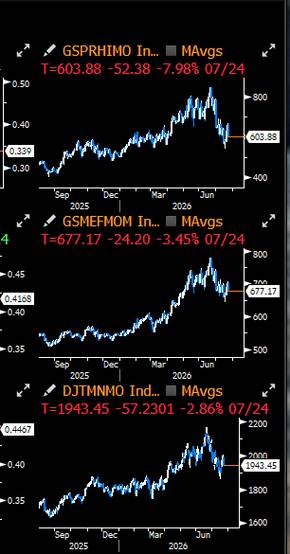
BBG | 7/24 close
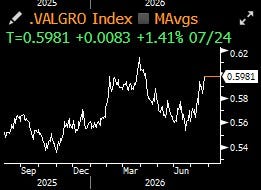
BBG .VALGRO | 7/24 close
So what: this is the de-rate. Not in the index, which held, but in the factor. A one-day eight percent move in a momentum basket is a liquidation, and it happened while the S&P closed up four handles. The index tells you nothing right now. The factor tells you everything.
FINANCIALS
The group is being carried by a curve that did almost nothing today, which is either the bull case or the whole problem depending on which subsector you own.
The numbers, off the terminal at 08:39: 10-year 4.6446, 2-year 4.3158, 2s10s +32.9bp. Friday’s par close was 4.69 and 4.33 for +36bp. So the curve came in three basis points at the long end and flattened slightly.
Worth being precise about the +30bp figure every sheet on my desk is carrying, because it is wrong and it matters. The actual spread is +32.9. Nearly three basis points of difference sounds like nothing until you put it against the KRE reactivation gate at +60bp. On the real number you are 27bp away. On the number the desks are quoting you are 30bp away. That is a tenth of the distance to a trigger, and distance to trigger is the only figure on a ladder that actually tells you to do something.
The driver of the day is dispersion, not direction.
Treating financials as one thing right now is the single most expensive mistake available in this sector.
At one end, capital markets. Goldman printed Q2 diluted EPS of $20.98 on net revenue of $20.34bn, up 39%, with the SpaceX fee flowing through and a jumbo IPO pipeline behind it, a dozen billion-dollar deals expected in the second half. JPMorgan booked the largest quarterly profit in the history of American banking at $21.2bn and sits at an all-time high. That is real and it is not a rate story, it is an issuance story, and issuance is paid by a reopening risk window. (Financials Daily)
At the other end, the private credit complex, and this is where the sector’s actual tail lives. Aggregate BDC non-accruals up 40% quarter on quarter to roughly 2.01% at cost, an estimated 3.24% adjusted. FSK at 8.1% non-accrual with the dividend cut 40% from peak. Ares capped Strategic Income redemptions at 5% against requests that hit 11.6%. BCRED lifted its cap to 7.9%. Non-traded BDCs saw their first-ever net outflow in Q1, with industry redemption requests estimated near $20.8bn. (Financials Daily)
Now hold those two facts next to each other. Public credit says nothing is wrong: IG CDS around 53, HY CDS around 316, HY OAS in the 273 to 277 range, comfortably inside the 300 gate. Private credit is gating redemptions. Those are the same borrowers. One market marks daily and the other marks quarterly, and the one that marks quarterly is the one turning people away at the door.
That is not a contradiction to resolve. That is the signal. Public spreads are not tight because credit is clean. They are tight because the stressed paper migrated somewhere that does not print a spread.
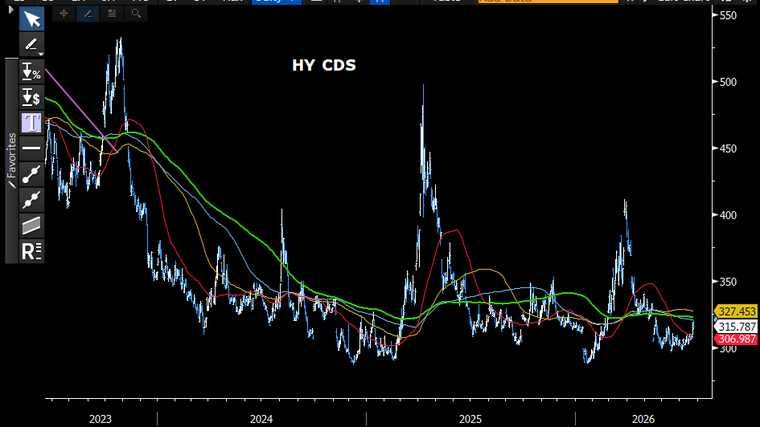
BBG | HY CDS
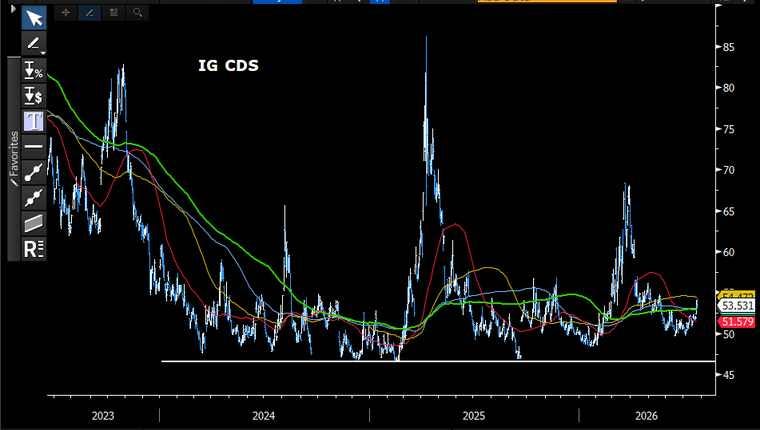
BBG | IG CDS
Consumer finance is the bright spot and the BNPL data is the tell against it.
Capital One domestic card charge-offs at 4.71%, down 39bp on the quarter and 54bp on the year, delinquency 3.39% and falling. Synchrony at 5.3%, down from 6.38% a year ago. Genuinely healing. But Affirm’s 30-plus delinquency sits at 2.8% with allowance at 6.0% of loans, and late-payment incidence across BNPL users has gone 34% to 41% to 47% over three years. That series leads bank charge-offs by four to six weeks and it has not shown up in COF or SYF yet. Prime is healing while the subprime edge frays. Both are true and only one of them is in the multiple.
Insurance is where the boredom pays. Hartford beat on operating EPS at $3.42 against $3.20 and the stock went down anyway, because the combined ratio told the real story. When a P&C name beats and trades off on underwriting, the pricing cycle is turning and you do not want to be adding. Brokers are the exception and the cleanest compounders in the sector, because they earn on volume rather than on loss ratios.
Positioning, and the sell-the-news problem. XLF is at the upper end of its 52-week range going into a Fed meeting. JPM is at an all-time high with zero percent off it. The Financials Daily has JPM tagged ‘long and crowded’ and GS ‘long’, with KRE the consensus underweight. That is a group with no surprise capacity to the upside and a very short walk to the downside if Warsh says something the room does not like.
So what: be long the fee engine and short the credit tail, inside the sector, and stop expressing financials as beta. XLF is not an idea. Long capital markets against the BDC complex is an idea, because it is the same regime call pointed at the two ends of one sector. Full expressions behind the wall.
SECTORS
Energy (XLE) The trapped side this morning and the one I’d stop shorting into. Majors report Friday, XOM and CVX, into a crude tape that just refused to hold its low.
Technology (XLK) Gapping on relief that has nothing to do with technology. MSFT and META Wednesday after the close, AAPL and AMZN Thursday. The gap gives no information about capex quality and the prints give nothing but.
Financials (XLF) Covered above. Upper end of the range into a live Fed. Leadership intact, surprise capacity exhausted.
Communication Services (XLC) Carrying the Alphabet hangover. Capex to $205bn at the upper end and free cash flow going the wrong way was the single most important equity event of last week and it is being papered over by an oil headline.
Utilities (XLU) The rate-relief expression everyone reaches for, plus a genuine data-center power bid that does not depend on the rate call. The catch: the rate-relief leg needs a 10-year I cannot currently verify.
Real Estate (XLRE) Led Friday on the average-member basis. Highest sensitivity to a long end that has not actually rallied. The 30-year at 5.16 refused to move on a seven percent oil drop and that is the whole rates story.
Health Care (XLV) Section 301 generic-drug exposure is the overhang. AstraZeneca beat on oncology this morning, core EPS $2.63 against $2.48.
Industrials (XLI) Boeing and UPS Tuesday. Watch freight commentary for the demand read that the equity market keeps refusing to take.
Consumer Discretionary (XLY) The retail-favorites collapse lives here and it is not being discussed. See flows.
Consumer Staples (XLP) Defensive bid on Friday’s tape. If the relief holds, dead money. If it doesn’t, the only place that works.
Materials (XLB) Copper is the one reflation leg that survives the oil fade, because grid and data-center power demand does not care about the Strait of Hormuz.
FLOWS & POSITIONING
Start with what is holding the index up, because it isn’t conviction.
Hedgeye has the S&P leaning negative gamma, which means dealers amplify rather than dampen, and structural flows light across vol control, CTAs and risk parity. The bands are 7,300 support and 7,550 resistance, and the one non-discretionary bid they can still identify is 401(k) contributions at roughly $33bn a month. (Hedgeye)
Read that again. The most reliable buyer in the American equity market is payroll deduction. Not allocation, not conviction, not a view on the discount rate. Automatic monthly purchase by people who are not looking at the screen.
Which explains the thing that has been bothering me for weeks and that Phil keeps asking about. The 10-year is at cycle highs and equities do not care. Why would they? The marginal buyer is not discounting cash flows. It is a payroll file. The rate level only starts to matter when it forces someone with discretion to sell, and the people with discretion have mostly already gone.
Goldman Prime has hedge funds extending global stock selling for a second straight week, with gross leverage down about five points. Short selling drove it. North America net bought while Asia EM and Europe were net sold. So the discretionary money is de-grossing while the payroll file keeps buying, and the index goes sideways because those two roughly cancel.
Now the part that is actually breaking. Goldman’s retail favorites basket ran to plus twenty percent in June and is now at plus two, while SPY holds around nine or ten. That is a twenty-point round trip in the retail book with the index essentially flat. Retail is not rotating. Retail is losing.
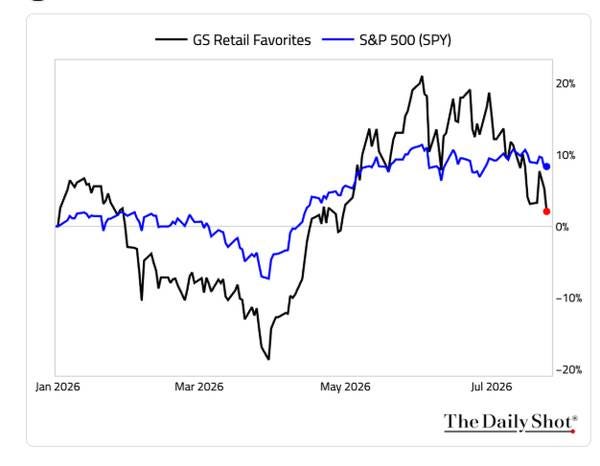
GS via The Daily Shot | 27-Jul-2026
Pair it with Friday’s factor tape: momentum down between 2.86% and 7.98% across five separate measures, value up 1.41%. The high-momentum, high-retail-ownership complex is being liquidated inside an index that is not moving. This is what a de-rate looks like when the cap-weighted top holds it up.
Tier1Alpha’s systematic positioning z-score sits near the upper band as of 24 July, with vol-control implied notional elevated. That is fuel in both directions and it is the reason to respect the gap, but positioning near the top of the band is not a bid, it is an inventory.
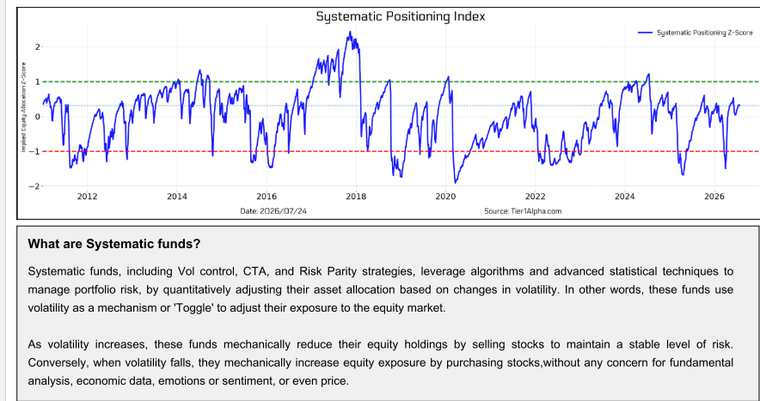
Tier1Alpha | 2026-07-24
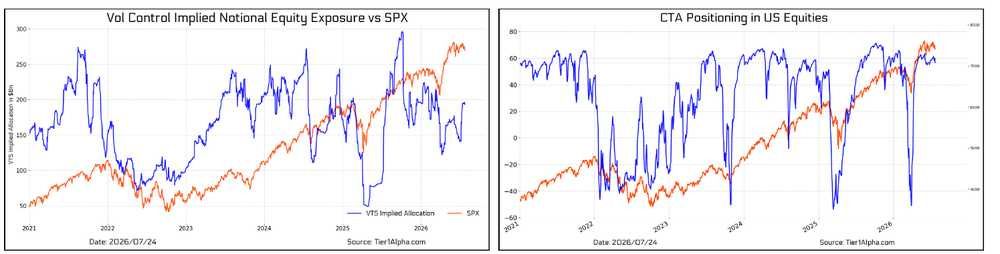
Tier1Alpha | 2026-07-24
Credit stays calm and I’ve said why I don’t fully trust it. IG CDS around 53, HY CDS around 316, both mid-range and neither confirming stress. The BBB-to-Treasury and junk-to-Treasury spreads against the E-mini show the same thing: no widening into any of this.
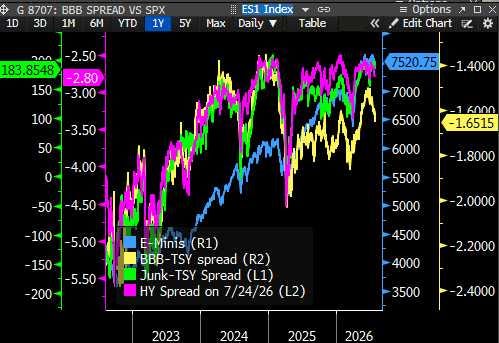
BBG | BBB and HY spread vs ES1
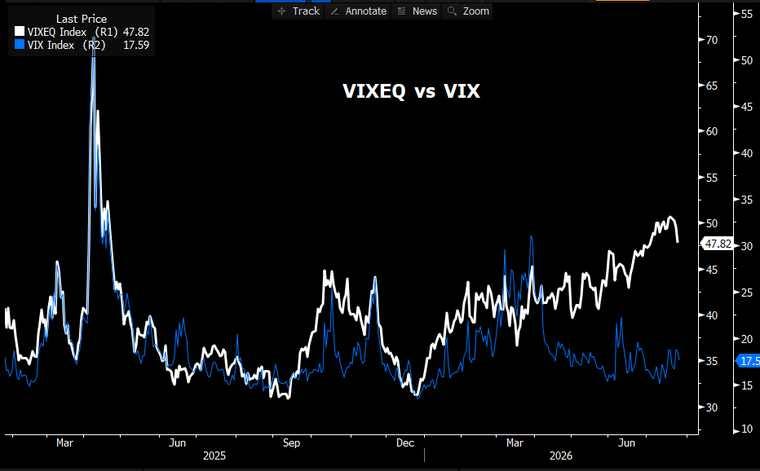
BBG | VIXEQ vs VIX
Cross-asset, the dollar is offered, EUR/USD up 0.20% at 1.13932 with the euro still near its 52-week low, DXY around 101.27.
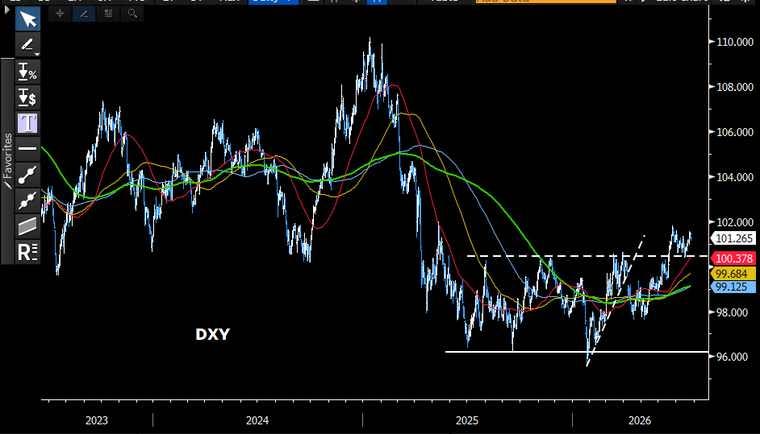
BBG | DXY
Bitcoin near 65,285, sitting in the channel that has contained it since the spring, and trading as pure risk beta with no independent signal. Yen a hair firmer at 163.60 against a 163.98 year high, which is to say still at four-decade lows.
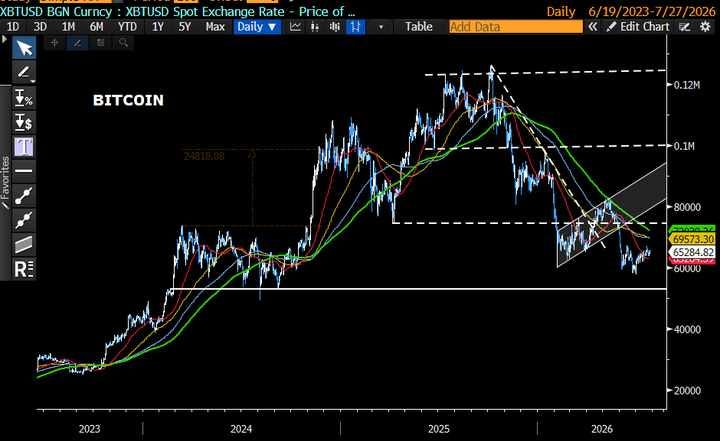
BBG | XBTUSD
And the flow that should worry anyone long dollars: net foreign purchases of US equities on a twelve-month total have gone near $900bn. That is a vertical line on a chart that has spent twenty years oscillating between minus three hundred and plus four hundred. It is not repeatable. When the marginal foreign bid normalizes, it does not need to reverse to hurt. It just needs to stop.
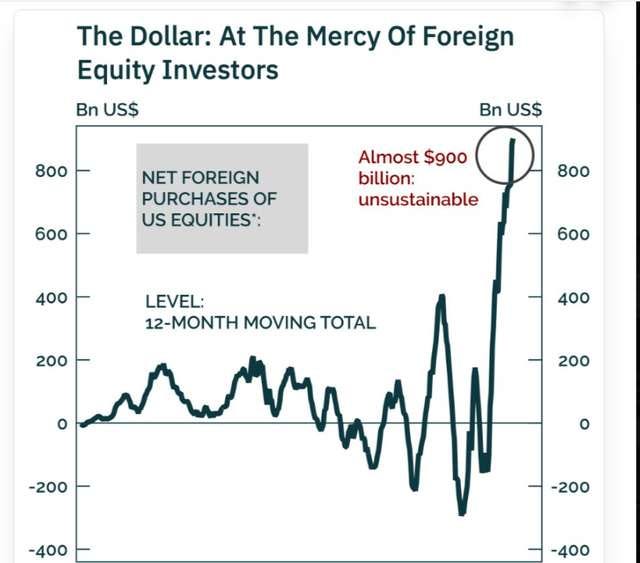
Chart via source deck
The midterm overlay. Goldman’s work has the S&P trading essentially sideways into election day, median and average both flat to slightly negative from July through November, with the ten-to-ninety percentile band widening the whole way.
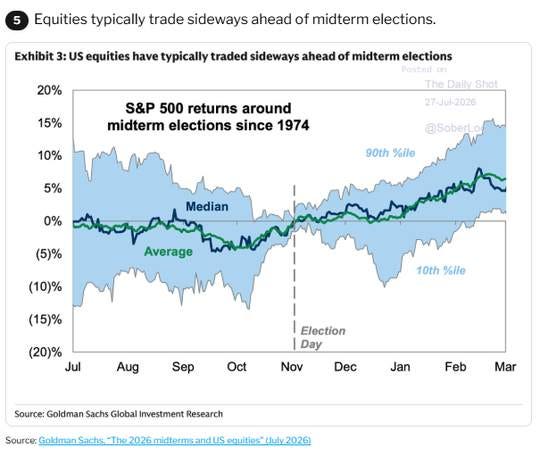
Goldman Sachs GIR via The Daily Shot | 27-Jul-2026
And median monthly realized volatility in midterm years runs above the all-year median in every single month from May through October, peaking around 20.8% in October against 13.9% in a normal year.
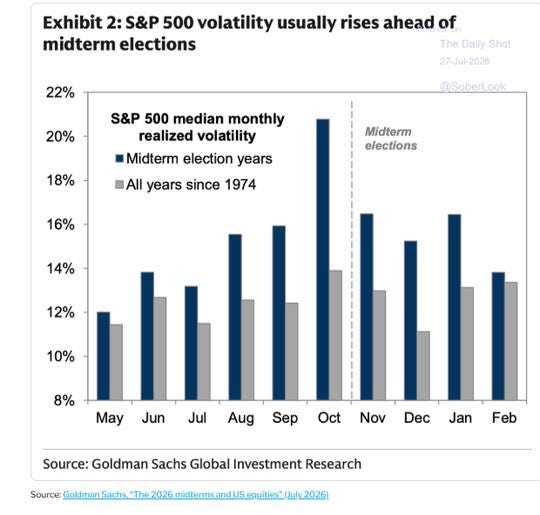
Goldman Sachs GIR via The Daily Shot | 27-Jul-2026
Today is 100 days out.
So: a sideways index, rising realized vol, negative gamma, light structural flows, retail liquidating, momentum unwinding, and a payroll file holding the bid. That is not a market that rallies. That is a market that grinds and then convulses.
THE BOX TRUMP IS IN
Worth spelling out, because it prices.
He cannot win this war. The munitions math says so, whatever he tells the Journal. Forty-five percent of Precision Strike Missiles and half the Patriot inventory in seven weeks, commanders rationing air defense, and a Joint Chiefs chairman telling him a wider campaign would leave his own people exposed. That is not a posture you escalate from. That is a posture you resupply from, slowly.
He cannot end it either. Iran has spent five months demonstrating it will absorb the damage, and Walter Russell Mead’s framing is the right one: this is an irrepressible conflict in Seward’s sense, where both sides see more reason to keep fighting than to quit. (WSJ) Tehran believes Washington’s resolve breaks first, and after five months of a five-to-six-week war, that belief is not obviously wrong.
So the two branches. Grind on through November and he owns a war with no exit, gas at four and a half dollars in Arizona, and a casualty ledger that has to be re-baselined to stay presentable. Stand down and take a pause that produces nothing, and the whole thing was for nothing, which is worse, because it is legible.
Approval near 39%. Democrats at their widest generic-ballot margin since the 2018 flip. And for the first time this term, more voters name the threat to democracy as the top issue than name the economy or the border.
That last number is the one I would watch, and not for the reason you think. A politician losing on the economy adjusts policy. A politician losing on legitimacy has a different set of incentives, and none of them involve a quiet October.
And France, which helped us exist, responded to the UN human rights vote, 144 for Türk and the United States one of ten against, by posting that America used to be a beacon and now stands with North Korea, Nicaragua, Mali and Russia. They hashtagged it AmericaAlone.
The President spent Sunday at the golf course posting AI images of himself as Cosmic Commander.
PAID BRIDGE
Behind the wall: the locked setup call with a single falsifier, the full book re-underwritten at this morning’s marks rather than carried on momentum, and six expressions with live entries where I have them and honest gaps where I don’t.
Specifically, you get the duration short re-underwritten at this morning’s terminal curve, including the uncomfortable fact that its trim trigger is four and a half basis points away, the long-value short-momentum expression that Friday’s factor tape just handed us, the oil-relapse hedge structured as a hedge and sized as one, why I am standing down the oil-down cluster that two other sheets are still long, and the two financials expressions, long the fee engine against the private credit tail, with the regional-bank reactivation held down behind a named trigger and the exact distance to it.
Plus the FOMC decision tree, conviction ranking, and the watchlist with levels.
Paid subscribers get the whole book every morning at morningmusing.com. The free half tells you what I think. The paid half tells you what I own, at what price, and the exact print that makes me wrong.
Keep reading with a 7-day free trial
Subscribe to Morning Musings- Thoughts from Dauber Island to keep reading this post and get 7 days of free access to the full post archives.